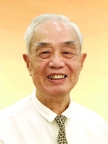
Student of Grand Master Wu Kung Yi
75th Anniversary Book, May 2012
In Memory of the Masters
During 1948, I had serious rheumatic heart disease, there was no improvement despite six months of treatment. Through the recommendation of a friend, I started to learn Tai Chi Chuan from Grand Master Wu Tai Chi at Kwong Wah Hong, Kowloon. After only three to four months of practicing Tai Chi Chuan, I felt better and I was able to reduce the medication. I was on and became devoted to the practice of Tai Chi Chuan with the strong believe that Tai Chi could improve my health.
As my motive to start Tai Chi was to cure my rheumatic disease, I had never thought about martial arts. Later on, when Grand Master Tai Chi taught me Pushing Hands, and after practising with my seniors, I started to realize Tai Chi Chuan was indeed a martial art and could be used in self defense, and my interest in its application grew. I was not an aggressive person, so when Pushing Hands, I emphasized 化(hua) instead of 發 (fa), so as not to provoke others.
I was present at the Wu-Chan Fight years ago. The Master drew with Chan which I believe was the true spirit of Tai Chi. As a result, I became more respectful of Tai Chi, which I have now practised for over 60 years.
Grand Master Wu Kung Yi told me that when he was young, he kept losing to his cousin Chiu SauTsun in Pushing Hands. He asked his father Wu Chien Chuan, who simply said “打是頂,不打是丟” (to fight is to resist, not to fight is retreat) and asked him to think it over. These seven Chinese words are very philosophical and worth our deep thoughts.
Besides Grand Master Wu Tai Chi, I also learned from Grand Master Wu Tai Kwei at the Kowloon Academy. Subsequently, I also had lessons from Grand Master Wu Kung Yi, Grand Master Wu Kung Cho, Grand Master Wu Tai Sin, Grand Master Wu Yan Hsia & Master Kwok Hsia Jong. However, I regret that even with all these great masters who have taught me, I am still not at the level I wish to achieve, I am still practising Wu Style Tai Chi Chuan diligently.
When I learned Pushing Hands, I captured a few pointers from the Masters; concentration, complete body relaxation, normal breathing, not to use brute force, body centering and stay natural. When practising the Form, maintain the center, be directional, accurate position and posture, in a non-speedy pace. The keys are to relax, be stable, perform at a slow, circular, even pace, the joints are connected and integrated, movements are arc-like, while in motion there is stillness, and while in stillness there is motion, and upper, lower, left and right body coordination.
When Pushing Hands, one has to observe and feel your opponent; 沾 (zhān)、粘 (zhan)、連 (lián) 、隨 (suí), do not 丟 (diủ) or 頂 (ding), take advantage of one's posture, and make use of one's force. We also need to follow the principles of yin/yang, fullness/emptiness, open/close, motion/stillness, circular externally and square internally, mind in circular but 勁 (jin) in square. Remember Tai Chi doesn't initiate actions with arms and hands. Hands are to be relaxed and sunken, shoulders are relaxed, and elbows sunken.
Finally, I would share the following Poem of Emptiness & Fullness:
虛虛實實神會中,虛實實虛手行功,練拳不諳虛實理,枉費功夫終無成,虛守實發掌中窮,中實不發藝難精,虛實自有虛實在,實實虛虛攻不空。