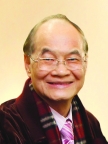
Disciple of Grand Master Wu Tai Kwei
75th Anniversary Book, May 2012
In memory of Master Wu Tai Kwei and in deep appreciation of the teaching provided by the Wu family
Due to having been born weak, I decided to learn Tai Chi Chuan in order to build up my body and become healthy. I started practicing at Wu's Tai Chi Chuan Kowloon Academy. After practising for seven years, I was honored to be chosen as a disciple by Grand Master Wu Tai Kwei, and I learnt and improved a lot through his coaching. I am writing this article while we celebrate the 75th anniversary of Wu's Tai Chi Chuan Academy Headquarters, in memory of Grand Master Wu Tai Kwei and those Wu's ancestors who have taught me, in order that other practitioners and disciples can learn more about them.
Systematic Coaching - to facilitate combat
Grand Master Wu Tai Kwei taught Tai Chi in a systematic way which built up my skills and knowledge progressively – the 108 standard form followed by the round form, 24-styles, push hands without foot work, then with foot work, and then close range combat by resolving forces, capturing and locking, free style push hands, normal range combat and power generation (exerting "jin").
Grand Master Wu Tai Kwei would only teach me one method of close range combat at a time. He would practice with me repeatedly until I was proficient with the method, and it became instinctive. He then taught me how the method can be defended against at the next class, and these has to be practised until they became instinctive before he would teach me other methods. All the wrestling and dropping techniques were practiced on ceramic floors, Grand Master Wu Tai Kwei did this on purpose so we would get used to break falling on hard floors.
Grand Master Wu Tai Kwei would do free style push hands with us one after the other, once we lost balance it was the next student's turn. He would still be relaxed after 7-8 of us had pushed hands with him. He said that free style push hands has to be learnt through experience, and they are all good moves as long as they were in line with Tai Chi principles. One who is at the highest skill level in close range combat, can apply the eight methods appropriately to move the opponent's spine by a mere half inch then, at the instant of body contact, knock down the opponent.
Grand Master Tai Kwei also taught us how to make use of a fraction of the opponent's incoming force, which he called "nervous system attack". When we practiced and were punched, it hurt so much the bruises wouldn't fade away for more than a week. If we practised with power, we strapped two pillows on our chest and on top added a shield used in fencing, but even with such protection, there was no guarantee that we wouldn't get hurt.
When Grand Master Wu Tai Kwei trained his disciples, he ensured the training was practical for martial arts purposes, enforced basic movements, push hands, resolve and capture, use of legs and feet, body movements and positioning as well as foot work, plus the psychology of combat. I remember well the "tiger and sick cat" theory, when facing a strong opponent, regard him as a sick cat, and look down on hím so not to be scared by him; while facing a weak opponent, treat him like a tiger, this way, you won't become care- less during combat.
The sword for lightness and flexibility, There can be no miss with a spear
Grand Master Tai Kwei taught us the Tai Chi Sword three times, each time it was slightly different, my guess is that there is no particular definitive style, what is important is that it is played in line with Tai Chi principles, and one is able to use the sword with ones mind, and according to the situation. For example, in the style "white snake spit tongue (白蛇吐信)”,one is supposed to thrust in the standard form, but if there is a wall right in front, Grand Master Wu Tai Kwei would use foot work to adjust and the change is amazing!
Grand Master Wu Tai Kwei told us that when we use a sword, the sword and eye sight must be inline. The basic principle is accuracy. He said the same went for the spear. As the Tai Chi Spear was originally to be used on horse back, he didn't practice it all the time. I remembered once he asked us to stack up two folding chairs. He turned suddenly and speared right when his eyes caught the chairs. The top chair was speared at the thinner side and it just flew away. He then applied a second spear at the wall, and left 5 holes shaped like a flower on the wall. What amazed us was the spear was nearly ten feet long, and it was vibrating like crazy at the spear head.
Admired in the West, Shock and Awe in the East
Once there were two British men, an amateur boxing champion, and an amateur fencing champion who came to the Academy. They wanted to try out Grand Master Wu Tai Kwei's kungfu, and I was asked to be the translator to the Grand Master.
The boxer attacked with a left hook, and Grand Master Wu Tai Kwei reacted by "Lean Back and Kick (48th movement-披身踢腳)”,and the boxer lost balance and fell forward. Grand Master's left foot was already in his groin area.
The fencer said the Chinese sword looked heavy and inflexible, while the western sword was lighter and more flexible than Chinese sword, and he couldn't imagine how the Chinese sword could be able to sustain the attack coming from the western sword. Grand Master Wu Tai Kwei replied by saying sword was an extension of one's arm, and only those who could deliver power all the way to the tip of the sword, were masters of sword. The sword man asked for a demonstration fight, and speared at Grand Master Wu Tai Kwei. Grand Master Wu Tai Kwei touched the fencer's sword with his, and delivered power to the tip of his sword; the fencer lost his grip and his sword twisted and flew out of his hand. Grand Master Wu Tai Kwei asked him to try again. He did and purposely held onto his sword tightly so the sword could not be dislodged, but this time the sword was sent back over 90 degrees by Grand Master’s power, and the fencer twisted and injured his wrist.
Tai Chi on Hong Kong TV
During 1967 and 1968, Redifusion TV invited Grand Master Wu Kung Yi to host a TV program "Tai Chi Chuan". The TV show lasted for just over 8 months, and was broadcasted live weekly. I was honoured to be responsible for explaining the theory behind the Form from the 2nd episode onwards. Grand Master Wu Kung Yi decided on the show contents while Chung Ngok Ping(鍾岳平) explained how each Form was played, and Choi Nei Biu(蔡乃標) would demonstrate. In the last episode, Grand Master Wu Kung Yi and his disciple Chung Ngok Ping demonstrated push hands applications. Before the live broadcasting, Grand Master Wu Kung Yi asked Chung to attack him from behind, and Grand Master Wu Kung Yi would use “Turn Body and Slap Face with Palm”(99th movement-轉身撲面掌) to counter. Grand Master Wu Kung Yi asked Chung to attack without any warning nor pre-determined position. During the live broadcasting, Chung followed Grand Master's instruction and attacked him from behind with full force. In the split second before he punched at Grand Master's back, Grand Master reacted instinctively; turned, resolved and fought back, and Chung was knocked off his feet and his lip cut.
Radio Television Hong Kong (RTHK) English Channel invited Wu's Tai Chi Chuan Academy to demonstrate in a two-part series, aimed to introduce Wu Style Tai Chi Chuan to the viewers. This time, Grand Master Wu Yan Hsia and Grand Master Wu Tai Sin led their disciples in demonstrating saber, sword and push hands, and I was responsible for writing the scripts and narration. The show was directed and the Tai Chi movements were filmed in an artistic way and the show was well received by viewers. The show greatly aroused interest in Tai Chi and the Academy became very well known.
Proud but humble with Tai Chi
Grand Master Wu Tai Kwei was a straight-forward man who spoke from his heart, carefree on minor things. He was approachable and humorous. After each class, he would join all the disciples for congee as a late night snack, and told us stories about“Wulin”(武林,Chinese saying of Kung Fu Community) that he learnt and witnessed while he traveled around with his grandfather and father. We found those stories eye-opening and interesting.
Grand Master Wu Tai Kwei was invited by Japan's Wu Shu community to visit Japan as guest of honor to demonstrate Tai Chi Chuan and exchange martial arts techniques and theories with them. The visit was big news in Japan. Grand Master Wu Tai Kwei traveled to Tokyo by cruise ship, and then visited Kobe, Osaka, and Yokohama. During the two months visit, he visited local Budokans(武道館), where the Japanese would demonstrate martial arts in front of him. They purposely made strikes right to his nose, but Grand Master Wu Tai Kwei wouldn't even blink. This stopped them from escalating their provocative behavior. Grand Master Wu Tai Kwei Wrote in brush.“我武維揚”(loosely translated as The Great Wushu). which the Japanese kept as a treasure. According to the Japanese, they believed Judo was originated from China, and was called“Jujitsu”(柔術). Tai Chi Chuan was highly respected and the Japanese called it the origin of Judo. The trip to Japan was very successful and Grand Master Wu Tai Kwei earned a lot of respect from the Japanese.
Grand Master Wu Tai Kwei shined with his great talent and skills in Tai Chi Chuan. He dedicated his life, traveled around Asia to spread and share the greatness of Tai Chi Chuan, with great success.