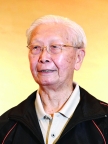
Disciple of Grand Master Wu Kung Yi
75th Anniversary Book, May 2012
My days in Kowloon Branch
On a summer day in 1956, I stepped into a flat on the 6th floor of 745D Nathan Road in Kowloon. It was the Kowloon Branch of Wu's Tai Chi Chuan Academy. From that date onwards, I established my bond with Wu Style Tai Chi Chuan. Over 50 years have lapsed since then. My Sifu was Grand Master Wu Tai Kwei, he was the Academy Director at that time. The assistant instructor was Lee Cheung Su who was also known as Lee Su. Lee Su later left the academy for personal reasons. I and a few other senior students were selected by Grand Master Wu Tai Kwei as assistant instructors. I was the most junior at that time.
Grand Master Wu Tai Kwei's kung fu was both amazing and superb. He was well known for his ability in martial art applications. Whenever Grand Master Wu Tai Kwei coached push hands in class, all students would pay serious attention to his form and movement. Grand Master Wu Tai Kwei used a “20%" rule whenever he pushed hands with a student. His 20% rule was that whenever he practised push hands with a student, he would just apply a little bit of pressure, which was just 20% above the the level of skill of the student; a rule that Grand Master Wu Tai Kwei would stick to no matter what was the level of the student. The reason that Grand Master Wu Tai Kwei used this 20% rule was that it would be much easier for the students to feel and digest the push hands technique. This is particularly useful as in push hands one needs to master the direction and strength of each push. If the push were too heavy the student would not be able to react to it and it would serve no practical purpose. Mastering push hands to the level of micro manipulation is actually extremely difficult and Grand Master Wu Tai Kwei at that time was well known and highly respected in the 'Tai Chi Chuan arena for his push hands.
Core members in the Academy in those days included Yip Su Liang (葉樹良), Fok Wing Chuen (霍永泉), Chan Cheong Lap (陳昌立), Tsui Yu Chung (徐汝松), Lee Kowk Wing (李國穎), Lee Kwok Shu (李國樞), Chan Yat Ming (陳日明), Ho Seng (何生), Keung Hok Chia (羗學齊), Yeung Ching Kong (楊澄江), Lee Yiu Tong (李耀棠), Lo Pak Tong (盧柏棠), Hui Shing (許成), So Wai Hung (蘇偉雄), Chung Ching (鍾正), Wei Nai Shek (衛勵石), Lee Kui (李僑), Tam Yiu (譚耀) and Wong Ku (黃駒). In July of 1963, Grand Master Wu Kung Yi decided to adopt disciples, and I was grateful to be nominated by Grand Master Wu Tai Kwei to become a disciple of Grand Master Wu Kung Yi. Thereafter, I addressed Grand Master Wu Tai Kwei as Eldest Si Hing.
Grand Master Wu Tai Kwei was well known for his ferocious real life combat. This attracted the attention of many martial arts practitioners, I personally observed Grand Master Wu Tai Kwei receiving a Judo visitor and a Fencing visitor. Both of them were obviously very surprised and complimentary about the high level of skill that Grand Master Wu Tai Kwei demonstrated and which they had no answer to.
Once I was also involved to a young guy who came with his mother to visit Mrs. Wu Tai Kwei. The guy was quite muscular. He was watching our Tai Chi class and commented that Tai Chi was only useful for health and made derogatory remarks about Tai Chi's practical application. Mrs. Wu Tai Kwei was a bit irritated by his impoliteness, and asked me to fight with him. I broke his nose.
Grand Master Wu Tai Kwei was a humorous man and treated all disciples well. In those days, So Wai Hung would sometimes prepare congee and fried flour rolls for us as supper after class in the evening. In Cantonese, there is an expression sometimes used to describe somebody who practices martial arts: "Had Eaten Late Evening Congee Meal". We demonstrated how such an expression might have come about. Sometimes we played mahjong after class. We had a marvelous time together with Grand Master Wu Tai Kwei in those days.
Unfortunately Grand Master Wu Tai Kwei passed away a few years later and the Kowloon Branch was subsequently demolished. A disciple called Hui Shing later arranged disciple meetings every Sunday at a school (宣道學校)to practice Tai Chi Chuan and push hands. After Hui Shing retired and emigrated we relocated to Ho Fung Secondary School led by Chan Cheong Lap. Classes have now taken place there for 30 years and it is one of the major training centers for Wu Style Tai Chi Chuan in Hong Kong.
Under the leadership of Grand Master Eddie Wu Kwong Yu, Wu Style Tai Chi Chuan has continued to develop both in Hong Kong and overseas. It gives me great pleasure to see Wu Style Tai Chi Chuan continue to flourish and give pleasure to new generations of practitioners both here and overseas.